
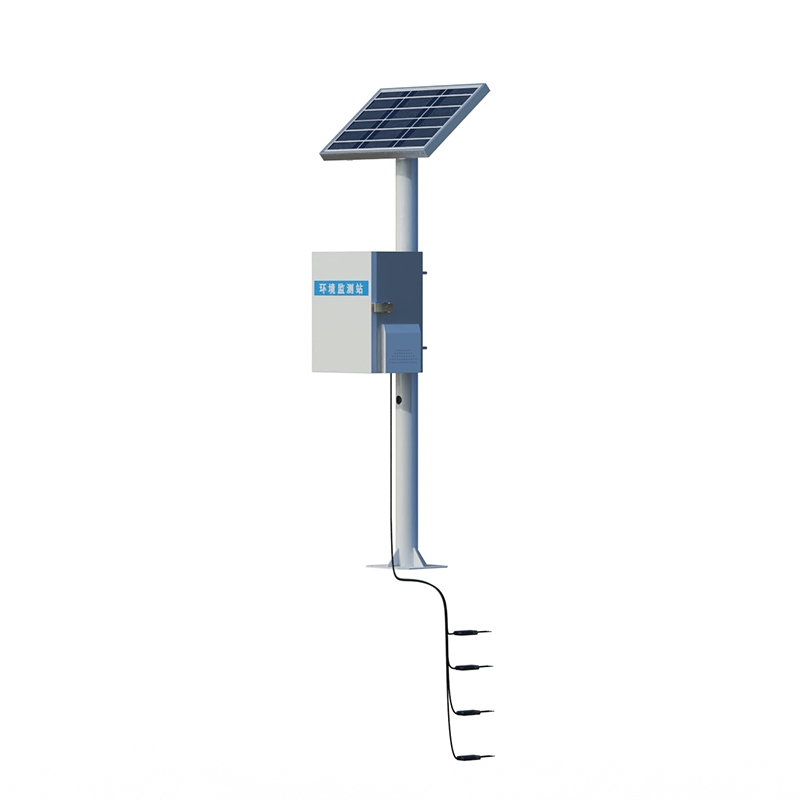
Integrated wireless meteorological and soil moisture monitoring station is an unattended monitoring device based on Internet of Things (IoT) technology, integrating sensors, wireless communication, and a data platform. It automatically collects soil moisture, temperature, and conductivity data, enabling remote transmission, threshold-based alerts, and continuous online monitoring. It primarily serves applications in agricultural meteorology and campus research.
Integrated wireless meteorological and soil moisture monitoring station is a system for continuous automatic monitoring of key soil parameters. Its core task is to obtain real-time data on soil moisture content, soil temperature, and soil electrical conductivity at specified locations, and transmit the data to a management platform via a wireless network. The system achieves full automation from data acquisition to analysis and application.
The core hardware of the monitoring station is a data acquisition terminal integrating multiple sensors. The terminal typically includes at least three sensor probes: a moisture sensor for measuring soil volumetric water content, a temperature sensor for measuring soil thermal state, and a conductivity sensor for measuring the total amount of soluble salt ions in the soil. These probes are buried in the soil at the desired monitoring depth, and their signals are processed by the terminal's main unit. The main unit's built-in IoT module is responsible for sending data to a cloud server or local data center periodically using wireless communication technologies such as 4G, NB-IoT, or LoRa.
The system's main functions revolve around automated data processing. It has real-time data acquisition capabilities, obtaining sensor readings at minute or hourly intervals. Thanks to wireless transmission, data can be remotely delivered to the user platform without manual on-site recording. The device has an internal storage unit that automatically saves data when the network is interrupted, ensuring complete records. Users can set safety thresholds for various parameters on the platform; when monitored values are abnormal, the system triggers an alert via SMS or software notification to management personnel. The platform also provides historical data querying, change curve plotting, and simple analysis tools to assist in decision-making.
In practical applications, the value of Integrated wireless meteorological and soil moisture monitoring station is mainly reflected in two aspects. In agricultural production, it is the basis for achieving precise irrigation and scientific fertilization. Continuously monitored soil moisture data guides irrigation timing and water volume, avoiding water resource waste. Soil temperature and conductivity data help assess soil temperature and salinity conditions, preventing frost damage and salinization problems. In campus meteorological monitoring or research scenarios, the device provides long-term, stable in-situ observation data, serving environmental research, teaching experiments, and science education. The technical characteristics of this system are its high integration and unattended operation. It combines Internet of Things (IoT) sensing technology, low-power wireless communication technology, and embedded data processing technology. The equipment typically uses a solar power system, enabling it to operate continuously in the field without mains power, truly achieving 24-hour continuous online monitoring. Its structural design considers waterproofing, dustproofing, and corrosion resistance requirements to adapt to complex outdoor environments. Users can flexibly add meteorological sensors such as air temperature and humidity, and light intensity sensors at the same site according to specific needs, forming a more comprehensive microclimate monitoring point.
In summary, Integrated wireless meteorological and soil moisture monitoring station transforms traditional field soil testing into a digital, networked, and dynamic monitoring process by combining sensor technology, wireless communication, and an IoT platform. It provides efficient and reliable data support for modern agricultural management, ecological environment research, and meteorological observation, and is an important tool for achieving refined production and intelligent monitoring.
This paper addresses:https://fengtusz.com/technical/896.html