

Product Center
-
Hydrological equipment monitoring station
-
Water Quality Monitor Sensor
-
Plant protection equipment
-
Food Testing Equipment
- How does Multi Depth Soil Moisture Probe achieve simultaneous measurement of soil temperature and humidity at multiple depths?
- The standard buoy five-parameter monitoring system enables automatic water quality data acquisition and remote transmission
- How the Tubular Soil Temperature and Moisture Monitor Achieves Simultaneous Multi-Layer Soil Parameter Measurement
- IoT Water Quality Monitoring Station enables the automatic acquisition and remote transmission of in-situ water quality monitoring data
- Soil Moisture Monitoring Enables Simultaneous Measurement of Soil Temperature and Moisture at Multiple Depths
- The high-spec buoy with five parameters enables more accurate lake water quality monitoring
Shandong Fengtu IOT Technology Co., Ltd
Sales Manager:Ms. Emily Wang
Tel, Whatsapp:+86 15898932201
Email:info@fengtutec.com
Add:No. 155 Optoelectronic Industry Accelerator, Gaoxin District, Weifang, Shandong, China
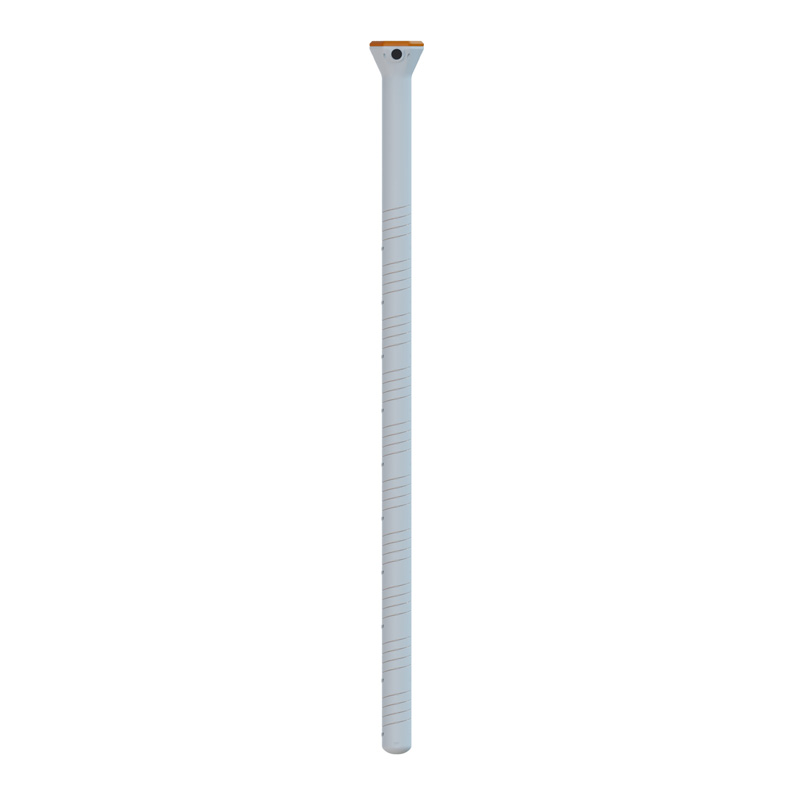
Tubular Soil Profile Moisture Tester
Model:FT-GS10
Brand:fengtu
 Get a Free Quote
Related products
Product details
1.Tubular Soil Profile Moisture Tester Product Introduction
Tubular Soil Profile Moisture Tester is a multi-section depth soil profile moisture monitoring instrument, can directly measure the moisture in the soil, temperature.The tubular soil sensor is a sensor used to monitor soil profile temperature, soil profile moisture, and soil profile conductivity. It integrates soil temperature, moisture, and conductivity and can be widely used in smart greenhouses, smart orchards, smart irrigation and other agricultural engineering fields.
2. Tubular Soil Profile Moisture Tester Product Parameters
Sensor start time: 60S
Sensor power supply voltage: DC12V
Sensor supply current: 22mA
Sensor power consumption: 0.26W
Communication method: 485 Modbus RTU protocol
Measurement parameters: 10 layers can be measured simultaneously
Measurement principle: A mathematical model is established by measuring the soil dielectric constant, and a spiral measuring electrode is designed to measure the soil volume moisture content data.
parameter | Measuring range | Accuracy | Resolution | unit |
Soil temperature | -30~70℃ | ±0.3 (-10~70℃) | 0.01 | ℃ |
Soil moisture | 0~100% | ±3% (loam) High organic matter soils (soil organic carbon content > 12%) High clay content soils (clay content > 45%) Calibration may be required for specific soil types due to their dielectric relaxation properties | 0.1% | --- |
Soil conductivity | 0~20000us/cm | ±3% (0~10000us/cm) ±5% (full scale) | 1 | us/cm |
3. Advantages and Features of Tubular Soil Profile Moisture Tester
★A single soil tube sensor can measure soil parameters at multiple depths simultaneously, and the monitoring depth can be customized (less than 1M).
★The sensor adopts low power design, with power consumption as low as 0.26W, suitable for long-term unmanned monitoring in the field.
★Each layer of the sensor can independently measure temperature, humidity, and conductivity parameters.
★The sensor shell is made of imported PC material, which is high in strength, corrosion-resistant and environmentally friendly.
★The sensor's waterproof rating reaches IP67, suitable for long-term outdoor monitoring.
★The sensor measures the average humidity in a certain area, making up for the limitations of single-point measurement.
★The sensor adopts a self-designed spiral measuring electrode to improve the contact between the sensor and the soil and minimize the measurement error caused by air gap.
4. Precautions for using Tubular Soil Profile Moisture Tester
a. The sensor should be used strictly in accordance with the installation and operating instructions.
b. When multiple sensors work at the same time, they must be separated by a distance of more than 3 meters.
c. The sensor measurement principle is limited. There should be no electromagnetic cables and strong magnetic radiation interference within a radius of 3 meters from the sensor measurement site to avoid huge errors and damage to the sensor measurement.
d. The installation environment of the sensor should be consistent with the measurement range of the sensor to avoid irregularities such as over-range.
e. The sensor should be installed away from strong acid, strong alkali, heavy oil, heavy metal environment.
f. The sensor is a soil measurement sensor. It is prohibited to use this sensor to measure other substances.
g. The sensor installation environment must not have strong vibration.
h. The sensor cannot be subjected to excessive external force.
i. Disassembly is prohibited. Unauthorized disassembly is considered as non-compliant behavior and no service will be provided subsequently.
5. Tubular Soil Profile Moisture Tester Installation Method
Drilling method:
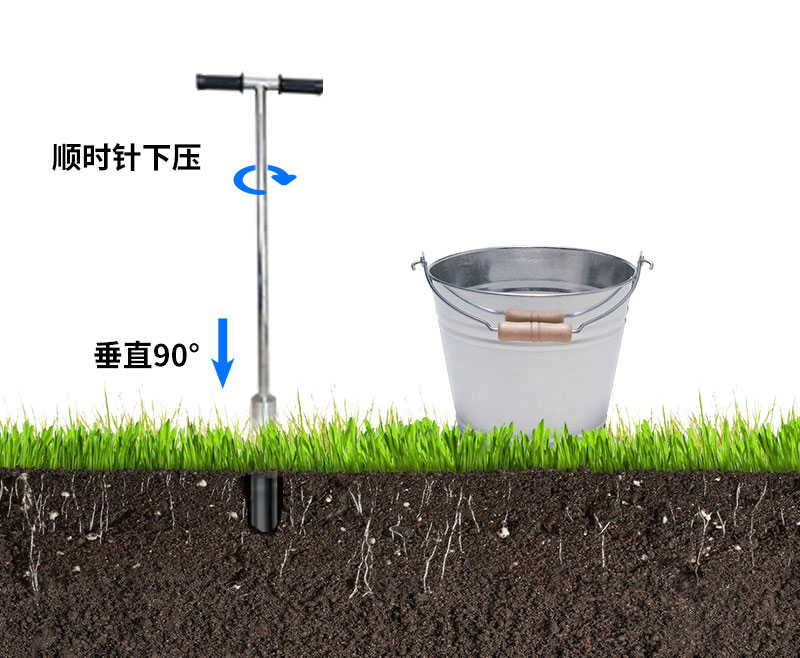
1. Take the drill bit, handle and support rod. After completion, place the drill vertically on the ground, hold the handle tightly with both hands and press down clockwise to rotate slowly. (Note: Do not use too much force, and be sure to rotate slowly for several circles to prevent the drill bit from deviating and causing the hole to be crooked)
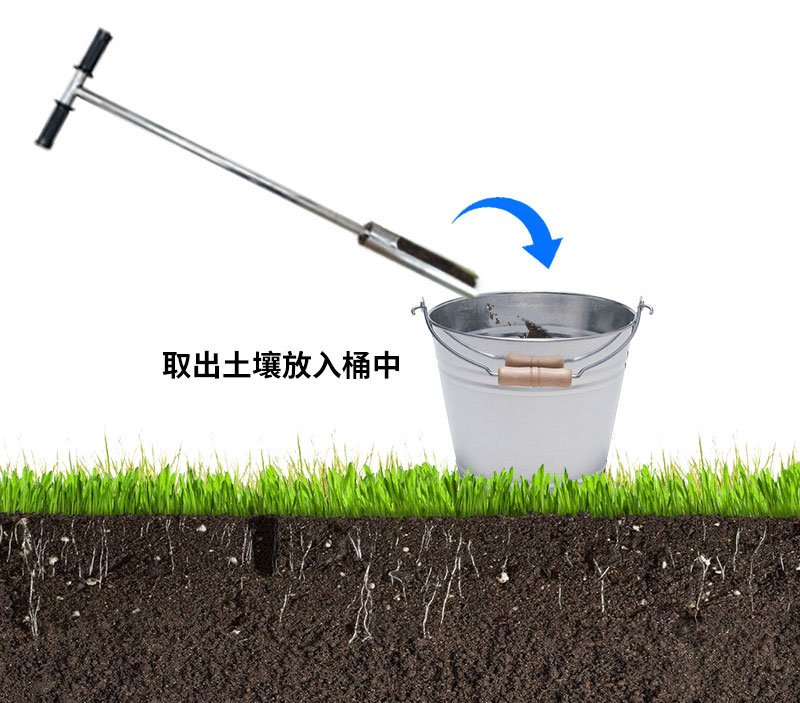
2. Take the soil drill out of the hole, put it in a basin, and use tools to collect the drilled soil into the basin for mixing with mud. (Note: The first drilled soil is not collected because it has too many impurities)
3. Repeat the above drilling and soil extraction process, and try to gently place the sensor into the hole (do not force the device to touch the bottom) to test whether the depth of the hole is appropriate; if there is a jam, use the soil extraction drill to correct it to ensure that the sensor is smoothly inserted and removed; until the hole depth is flush with the installation position marked by the sensor (zero scale line), the drilling is completed.
4. Pick out the soil impurities, stones, roots, and insoluble soil clods in the pot. Rub the soil finely to make mud.
5. Pour in an appropriate amount of water and stir thoroughly until it becomes viscous; loam mud should generally not be thicker than "sesame paste".
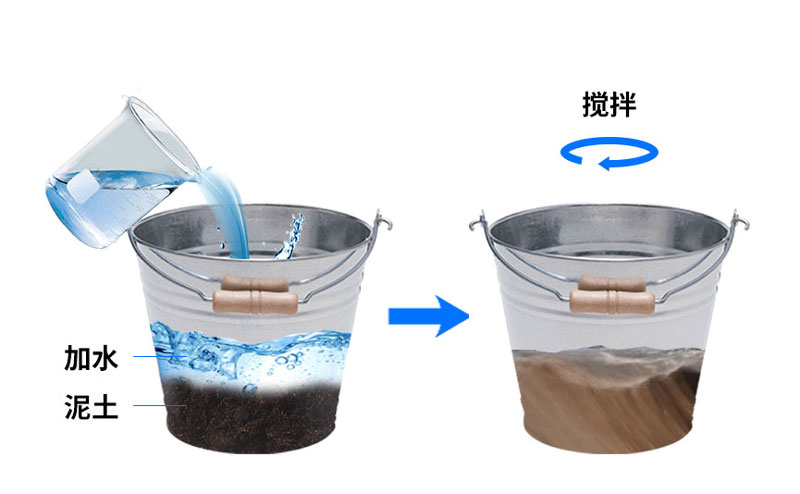
6. Slowly pour the mud into the hole, about 1/2 of the hole; the amount can be increased or decreased as appropriate based on actual conditions.
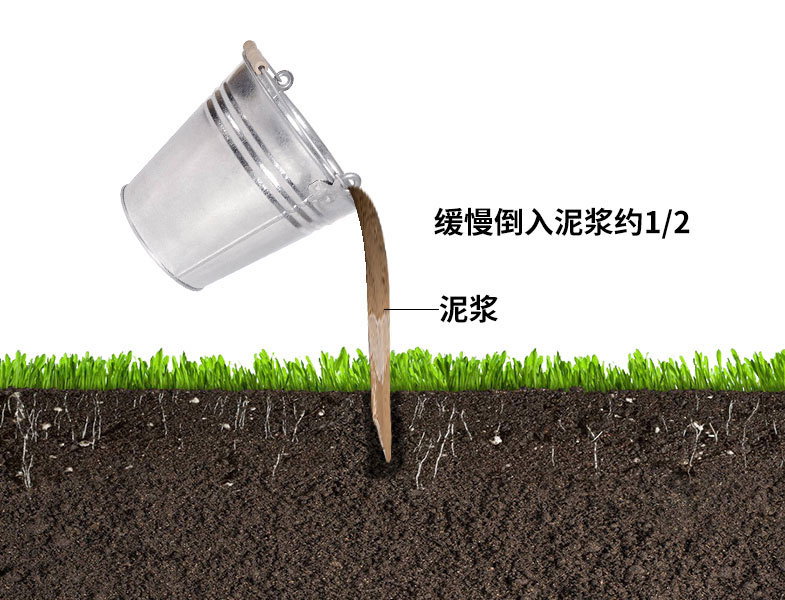
7. Slowly put the sensor into the hole, turn it clockwise and press it down. Too fast may cause the bubbles to not be completely discharged. (Note: Do not pull up the sensor during the turning and pressing process to prevent the gas from being sucked into the hole again)
8. When the sensor is installed to the correct depth, some mud will overflow around the device, and the grouting is completed; at this time, the sensor installation depth is flush with the hole. (Note: remove the excess mud outside 3CM around the sensor to prevent agglomeration from affecting water infiltration)
Burial method: Use a pickaxe to dig a deep pit for the sensor, and bury the sensor with mud. Refer to the drilling method for processing details.
This paper addresses:https://fengtusz.com/soil-moisture-monitoring-system/Tubular-Soil-Profile-Moisture-Tester.html
- Previous Article :Automated Soil Climate Monitoring
- Next Article:Soil moisture monitor
Related article
-
GNSS Monitoring Stations in Tunnel Deformation Detection
2025-08-05 -
Soil Moisture Temperature and Conductivity Rapid Tester Precisely Detects Multiple Soil Parameters
2026-03-06 -
Soil Moisture Monitors: Enabling Scientific Agricultural Moisture Management
2025-08-08 -
Pre - flood Season Preparedness in Mining Areas with Geological Disaster Monitoring System
2025-03-24 -
Introduction to real-time locust monitoring instruments
2024-03-15 -
Weather monitoring station manufacturers recommended
2024-04-12 -
River Flow Monitoring How to Improve the Accuracy of Water Level and Flow Rate Measurement?
2026-05-21 -
Essential River flow monitoring system: Navigating the Complexities of Riverine Data
2024-11-25