
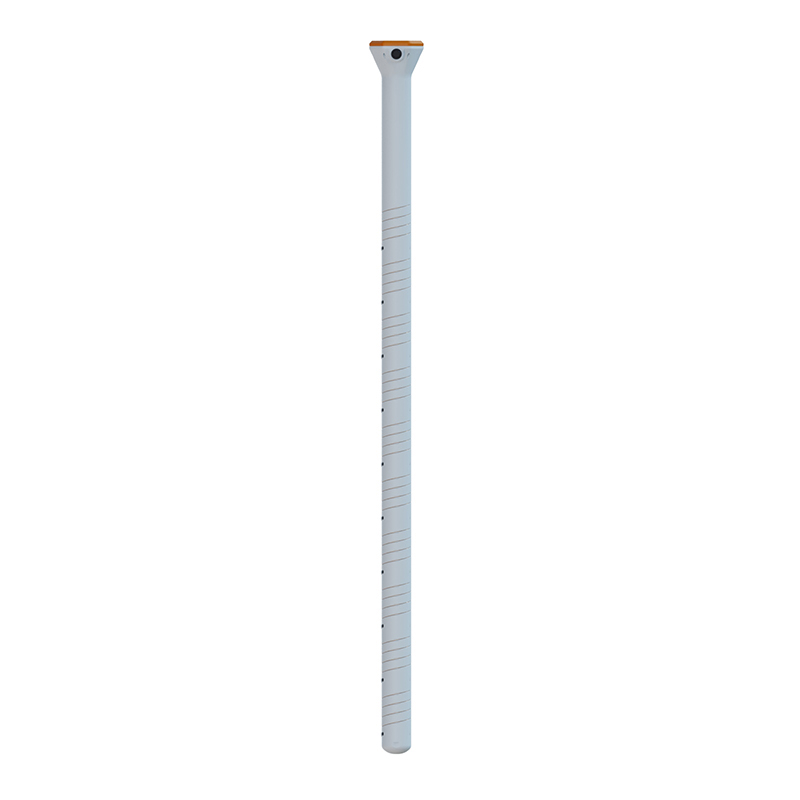
Tubular Soil Moisture Monitor Utilizing the principle of Frequency Domain Reflectometry (FDR), this device simultaneously measures soil temperature, moisture, and conductivity at various depths. It features a measurement range of 0–100% for moisture and 0–20,000 µS/cm for conductivity. Data is transmitted wirelessly to a remote cloud platform, making the device ideal for smart irrigation and agricultural engineering applications.
Tubular Soil Moisture Monitor is a multi-parameter intelligent monitoring device that integrates the measurement of soil temperature, moisture, and conductivity. It employs a tubular probe designed for vertical burial in the soil, allowing for the simultaneous acquisition of soil parameters at different profile depths. The device operates based on the FDR principle; by detecting frequency shifts in electromagnetic waves—emitted by its sensors as they pass through substances with varying dielectric constants—it rapidly calculates soil moisture content and salinity levels, while simultaneously performing direct measurements of soil temperature. The measurement range covers soil temperatures from -30°C to 70°C, soil moisture from 0% to 100%, and soil conductivity from 0 µS/cm to 20,000 µS/cm. Specifically, the soil temperature accuracy reaches ±0.3°C (within the -10°C to 70°C range), moisture accuracy is ±3%, and conductivity accuracy is ±3% within the 0 to 10,000 µS/cm range.
The device features an integrated tubular structure and comes standard with four layers of soil temperature and moisture sensors. It offers a maximum monitoring depth of up to 2 meters, with a minimum vertical spacing of 10 centimeters between monitoring layers; users may customize the depth and number of layers according to their specific requirements. The housing features a fully sealed, IP67-rated design, allowing it to remain deployed in fields and open ground for long-term, uninterrupted data collection. Constructed from either PVC or 304 stainless steel, the device is engineered to withstand operating environments ranging from -30°C to 70°C. Regarding power supply, the device offers three options: solar power, 220V AC mains power, or an internal long-life lithium battery. Its low-power consumption design ensures continuous operation for over 15 days, even under overcast or rainy weather conditions.
In terms of data transmission, the device supports the RS485 Modbus RTU communication protocol, enabling the real-time uploading of collected data to a centralized management cloud platform. It includes a dedicated cloud-based data management platform and a mobile application (APP), allowing users to access real-time data—including soil moisture, temperature, and conductivity readings—as well as historical trend charts and GPS location information, directly via a web browser or their mobile device. The platform supports data download, analysis, and printing functions; it allows for the configuration of moisture thresholds, triggering dual-channel alerts—via both SMS and the platform interface—should these limits be exceeded. The device features a built-in vibration-based anti-theft sensor, which automatically pushes an alert to the mobile application whenever external force is applied to remove the unit.
The Tubular Soil Moisture Monitor device is widely deployed across various agricultural engineering sectors—including smart greenhouses, smart orchards, and smart irrigation systems—where it serves to guide decision-making regarding irrigation and fertilization, thereby facilitating water-efficient irrigation and the optimal utilization of water resources. Furthermore, it is utilized in scenarios such as drought monitoring, soil research, crop yield forecasting, and landslide early warning systems, providing users in the water management and agricultural sectors with continuous, high-precision online monitoring data on soil parameters. For soils characterized by high organic matter content or high clay content—owing to their specific dielectric relaxation properties—the device is capable of automatically correcting measurement deviations based on an internal soil-type database, thereby ensuring the accuracy of the data.
This paper addresses:https://fengtusz.com/industry/962.html