

Product Center
-
Hydrological equipment monitoring station
-
Water Quality Monitor Sensor
-
Plant protection equipment
-
Food Testing Equipment
- How does Multi Depth Soil Moisture Probe achieve simultaneous measurement of soil temperature and humidity at multiple depths?
- The standard buoy five-parameter monitoring system enables automatic water quality data acquisition and remote transmission
- How the Tubular Soil Temperature and Moisture Monitor Achieves Simultaneous Multi-Layer Soil Parameter Measurement
- IoT Water Quality Monitoring Station enables the automatic acquisition and remote transmission of in-situ water quality monitoring data
- Soil Moisture Monitoring Enables Simultaneous Measurement of Soil Temperature and Moisture at Multiple Depths
- The high-spec buoy with five parameters enables more accurate lake water quality monitoring
Shandong Fengtu IOT Technology Co., Ltd
Sales Manager:Ms. Emily Wang
Tel, Whatsapp:+86 15898932201
Email:info@fengtutec.com
Add:No. 155 Optoelectronic Industry Accelerator, Gaoxin District, Weifang, Shandong, China
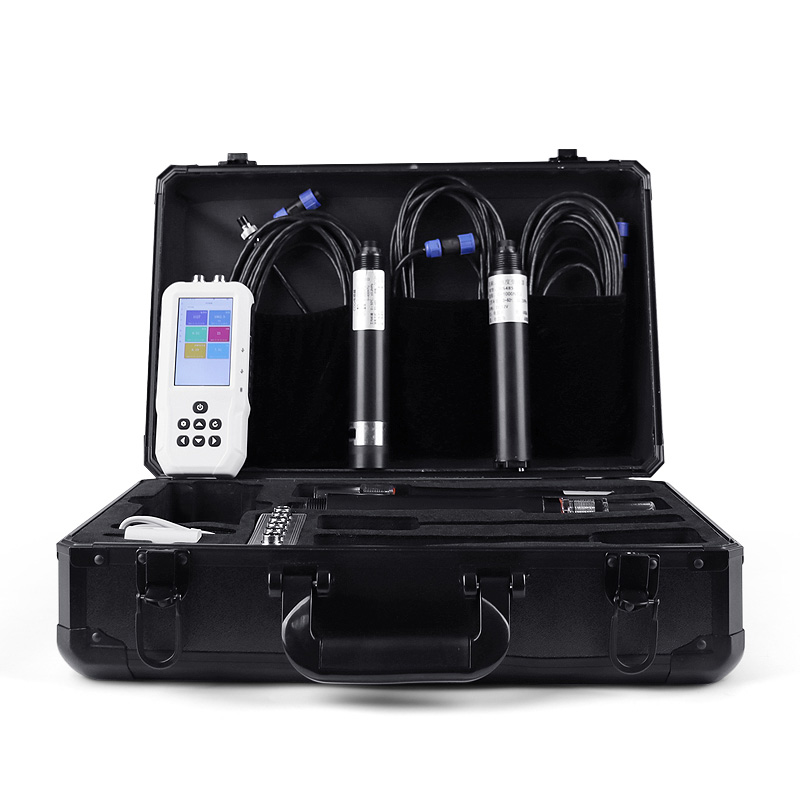
ORP Meter
Model:FT-SS6
Brand:fengtu
 Get a Free Quote
Related products

Product details
1. ORP Meter Product Introduction
ORP Meter is a laboratory instrument used to measure the REDOX potential value of water quality. It is used to determine the REDOX potential value of aqueous solution.SS6 model ORP Meter is an electrode method water quality analysis instrument that uses fully digital electrode detection to detect water quality ORP parameters.The instrument is equipped with the self-developed ftiot operating system, which is simple to operate, has stable performance, accurate measurement, and wide detection range.It has a built-in high-capacity rechargeable lithium battery, making it convenient for users to conduct water quality testing at any time in the field or laboratory.
2.ORP Meter host parameters
| Charging input voltage | 4.5V-5.5V |
| Charging current | <2A |
| screen size | 3.5 inches |
| screen resolution | 480*800☆ |
| screen interface | MIPI DSI☆ |
| USB interface | 2 (Supports external expansion of mouse, keyboard, 4G, etc.)☆ |
| Type-C | 1 (Supports external expansion of mouse, keyboard, 4G, etc.)☆ |
| RS485 | 2 (Supports Modbus, json, asc input, etc.) |
| External sensor supply voltage | 12V |
| External sensor supply current | 1A |
| operating system | ftiot (based on Linux-5.4)☆ |
| CPU | 2*Cotex-A7, 650Mhz☆ |
| RAM | 512M DDR3☆ |
| Flash | 8G-64G |
| OpenGL | ES 2.0☆ |
| Wifi | support |
| 4G | Optional |
| button | support |
| capacitive touch screen | support |
| software architecture | B/S☆ |
| web access | Support☆ |
| MTP mode | Support☆ |
| Multiple terminal login | Support☆ |
| IPV6 | Support☆ |
| Sensor communication method | RS485, TCP, UDP, HTTP☆ |
| Data forwarding method | RS485, TCP, UDP, HTTP☆ |
| Remote SSH | Support☆ |
| remote debugging | Support☆ |
3.ORP Meter sensor parameters and configuration
| serial number | name | Measuring range | principle | Measurement accuracy | Configuration | Remark |
| 1 | temperature | 0~50℃ | High-precision digital sensor | ±0.3℃ | ||
| 2 | pH | 0~14(ph) | Electrochemistry (Salt Bridge) | ±0.1PH | ||
| 3 | ORP | -1500mv~1500mv | Electrochemistry (Salt Bridge) | ±6mv | ✔ | |
| 4 | Conductivity | 0~5000uS/cm,0~10000uS/cm | contact electrode method | ±1.5% | ||
| 5 | TDS | 0~20μS/cm (TDS 0-10mg/L) | contact electrode method | ±1.5% | ||
| 6 | salinity | 0-2.5ppt or 0-80ppt | contact electrode method | ±0.05ppt or ±1ppt | ||
| 7 | Sludge concentration | 0~20.000g/L | scattered light method | ±5% (depending on sludge homogeneity) | ||
| 8 | Turbidity | 0~40NTU (low turbidity) | scattered light method | ±1% | Optional | |
| 0~1000NTU (medium turbidity) | scattered light method | ±1% | ||||
| 0~3000NTU (high turbidity) | scattered light method | ±1% | ||||
| 9 | Dissolved oxygen | 0~20mg/L | fluorescence lifetime method | ±2% | ||
| 10 | Ammonia nitrogen | 0-1000.00mg/L (default) 0-100.00mg/l/ (customizable) | Ion selective electrode method | 10% of reading, ±0.5℃ | ||
| 11 | suspended solids | 0~2000mg/L | scattered light method | ±5% (depending on sludge homogeneity) | ||
| 12 | Residual chlorine | 0~5.00mg/L | Ion selective electrode method | ±5% of reading | The accuracy is best when the flow rate is 0.42m/s-0.85m/s. | |
| 13 | Chloride ions | 0-3500.0mg/L | Ion selective electrode method | ±5% | ||
| 14 | Total hardness | 0~1000.0mg/L | Ion selective electrode method | ±10% of reading | ||
| 15 | cod | 0~500mg/L | UV254 absorption method | ±5% | COD and chlorophyll are equipped with automatic cleaners to prevent biological adhesion and avoid light window pollution to ensure long-term monitoring is still stable; the automatic cleaning time and cleaning frequency can be set, and the power consumption is 0.7W | |
| 16 | Chlorophyll | 0~400ug/L | Fluorescence method | R2>0.999 |
This paper addresses:https://fengtusz.com/Portable-Water-Quality-Monitor/ORP-Meter.html
- Previous Article :Portable ph meter
- Next Article:Conductivity Meter
Related article
-
Soil Moisture Monitoring Station: Enabling Precise Irrigation and Supporting Sustainable Agricultural Development
2025-07-23 -
The Introduction and Impact of Water Quality Monitoring Station in a Sewage Treatment Plant
2025-03-14 -
The high-spec buoy with five parameters enables more accurate lake water quality monitoring
2026-07-21 -
FT - CS50 Portable Ultrasonic Water Depth Meter: Empowering Accurate Water Depth Detection in Diverse Water Environments
2025-04-27 -
Small automatic water quality monitoring system Real-time Monitoring of Water Temperature, Conductivity, pH, and Multiple Water Quality Parameters
2025-12-30 -
Online Ammonia - Nitrogen Sensors: Pivotal Tools in Understanding, Measuring and Solving Ammonia - Nitrogen Issues
2025-02-18 -
The Critical Role of Dissolved Oxygen Sensors in Fish Farming and Water Health
2025-05-15 -
Water quality multi-parameter analyzer can be used for fishery farming, water monitoring ......
2024-07-19